This month, we’re kicking off a new summer series exploring some of the most commonly used public health theories that help explain why people make the health decisions they do.
Public health programs are often designed around theories that help us understand behavior. Some of the most widely used theories include the Health Belief Model, Social Cognitive Theory, the Theory of Planned Behavior, and the Transtheoretical Model.
We’ll spend the next few months taking a closer look at each one.
This month, we’re starting with the Transtheoretical Model, also known as the Stages of Change Model.
What Is the Transtheoretical Model?
The Transtheoretical Model is based on the idea that behavior change is a process rather than a single event.
Most people do not make a life change overnight. Typically, we move through a series of stages and emotions before a new behavior becomes part of our daily lives.
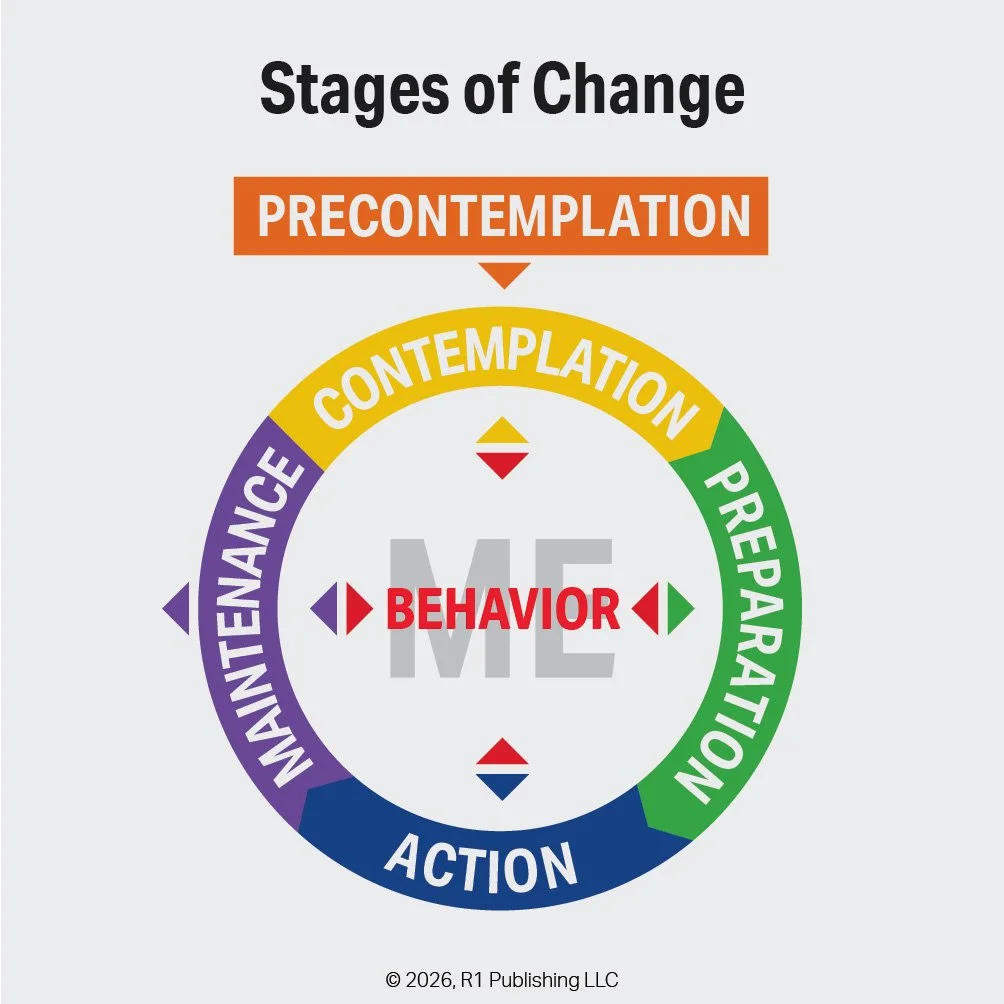
The model proposes five primary stages:
-
- Precontemplation
- Contemplation
- Preparation
- Action
- Maintenance
The model recognizes that individuals can be at different points in their journey and that effective public health programs need to understand where someone is in that process and support them where they are.
Behavior Change Doesn’t Happen All at Once
Think about a behavior like smoking cigarettes.
Most people don’t wake up one morning and immediately stop smoking forever. Instead, they move through several stages before lasting change occurs.
Let’s look at how that process might unfold with the Transtheoretical Model.
Precontemplation
In the precontemplation stage, individuals are not thinking about changing their behavior.
They may not recognize that a problem exists, may not understand the risks associated with the behavior, or may simply have no interest in making a change.
For example, a person who uses tobacco products may be perfectly content with their current behavior and unconcerned about potential health consequences.
At this stage, they are not considering quitting.
Contemplation
In the contemplation stage, individuals begin thinking about change but are not yet ready to take action.
They recognize that a behavior may be causing problems and start weighing the pros and cons of changing it.
For someone who uses tobacco products, this might mean thinking about quitting while continuing to smoke.
Often, movement into this stage is triggered by an important event like a health scare, a conversation with a doctor, or seeing a loved one experience health challenges, which can all prompt someone to start considering change.
Preparation
In the preparation stage, individuals intend to take action and begin planning for change.
They may gather information, set goals for themselves, identify resources to help them quit, or make small adjustments that move them toward a new behavior.
For someone preparing to quit smoking, this might include setting a quit date, talking with a healthcare provider, or learning more about nicotine replacement products.
Action
The action stage is where behavior change becomes visible.
Individuals actively modify their behavior and start implementing the plans they developed during the preparation stage.
In our smoking example, this is when a person stops using tobacco products and begins working toward their goal of remaining tobacco-free.
Maintenance
The maintenance stage focuses on sustaining change over time.
Individuals continue practicing their new behavior and develop strategies to prevent returning to old habits.
For someone who has quit smoking, this might mean avoiding triggers, seeking support when needed, and continuing healthy coping strategies that help them remain tobacco-free.
Change Is Often Cyclical, Not Linear
One important limitation of the model is that it can appear very linear.
In reality, behavior change rarely follows a straight path.
People may move from preparation to action and then return to contemplation. Someone in maintenance may experience a relapse and need to begin the process again.
Rather than viewing relapse as failure, the model recognizes that setbacks are often a normal part of behavior change.
Each attempt can provide valuable experience that supports future success.
How Public Health Programs Use This Model
Public health programs often use the Transtheoretical Model to tailor interventions to an individual’s stage of change.
Rather than providing the same support to everyone, programs can offer resources that match where a person is in their journey.
For example:
-
- Someone in precontemplation may benefit from education and awareness-building.
- Someone in contemplation may need support weighing the benefits of change.
- Someone in preparation may need help creating an action plan.
- Someone in action or maintenance may benefit from ongoing support and accountability.
By meeting people where they are, programs can more effectively support long-term behavior change.
What This Means for Our Work at CHIRP
The Transtheoretical Model reminds us that behavior change is complex because human beings are complex.
People don’t always change just because they have the information. They don’t always change after one intervention. And they don’t always move forward in a predictable way.
Understanding the stages of change helps us design programs that are realistic, supportive, and responsive to the needs of the people they serve.
At CHIRP, theory helps guide the way we think about program design, implementation, and evaluation. By understanding how and why people change behavior, we can help organizations develop programs that are more likely to create meaningful and lasting impact.